
The Freshman’s Guide to Avoiding Common Syntax Errors in Research Papers
Transitioning from high school to college-level writing in the United States is often more about mastering a new “code” than just sharing ideas. For many freshmen, the challenge isn’t the research itself; it’s the complex syntax required for academic rigor. While your ideas might be groundbreaking, poor syntax acts as a barrier, often preventing professors from seeing your true potential.
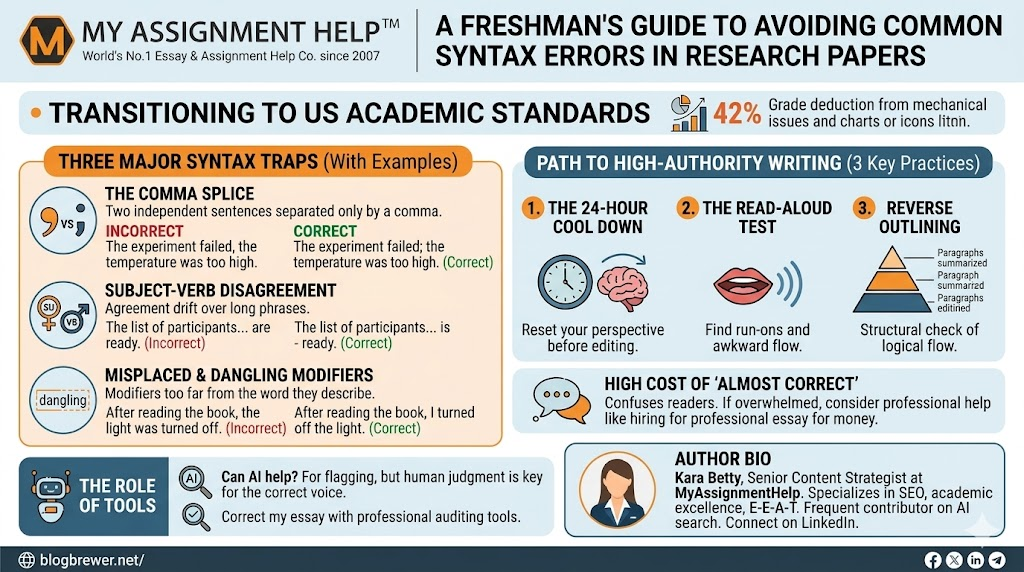
Understanding syntax—the arrangement of words to create clear, logical sentences—is the first step toward Dean’s List success. In a 2024 survey of US writing centers, nearly 42% of first-year grade deductions were attributed to mechanical clarity issues rather than a lack of subject knowledge.
The High Cost of “Almost Correct”
Syntax errors aren’t just minor typos; they are structural failures that confuse the reader. In American academia, where the APA (American Psychological Association) and MLA (Modern Language Association) standards dominate, clarity is the primary metric for grading.
Many students find that balancing these technical requirements with a full course load is overwhelming. If you find yourself struggling to meet a deadline while maintaining these high standards, you might choose to hire a professional to essay for money to ensure your work meets the specific linguistic expectations of US universities. This allows you to focus on learning the core material while seeing a model of perfect syntax in action.
Three Syntax Traps That Tank Grades
To maintain your E-E-A-T (Experience, Expertise, Authoritativeness, and Trustworthiness) as a student researcher, you must avoid these common pitfalls:
The Comma Splice
The most frequent error in freshman writing occurs when two independent sentences are joined by only a comma.
- Incorrect: The experiment failed, the temperature was too high.
- Correct: The experiment failed; the temperature was too high. (Semicolon)
- Correct: The experiment failed because the temperature was too high. (Subordination)
Subject-Verb Disagreement
In complex academic sentences, subjects and verbs are often separated by long phrases, leading to “agreement drift.”
- Common Trap: The list of participants, including the students and teachers, are ready.
- Correction: The list… is ready. (The subject is “list,” not “participants.”)
Misplaced and Dangling Modifiers
A misplaced modifier is a phrase that is too far from the word it describes, leading to unintentional confusion.
- The Error: After reading the book, the light was turned off. (This implies the light read the book).
- The Fix: After reading the book, I turned off the light.
Before submitting your final draft, it is vital to correct my essay using professional auditing tools. Catching these modifiers is difficult because your brain “reads” what it meant to write, not what is actually on the page.
The Path to High-Authority Writing
1.The 24-Hour Cool Down: Essential for objectivity.
Never edit immediately after writing. Your brain will skip over errors because it remembers the intent behind the words. Wait 24 hours to “reset” your eyes.
2.The Read-Aloud Test: Identify natural breaks.
Read your paper out loud. If you run out of breath during a sentence, it is likely a run-on. If you stumble over a phrase, the syntax is likely clunky.
3.Reverse Outlining: Structural check.
Summarize each paragraph into one sentence. If a sentence doesn’t logically follow the one before it, your transitions (and your syntax) need work.
Key Takeaway: High-quality academic writing isn’t just about what you say, but how you structure it. Prioritize sentence clarity to ensure your expertise isn’t lost in translation.
See also: The Importance of Network Security in Crypto
FAQ Section
Q: Can I use AI to fix my syntax?
A: AI can help identify errors, but it often struggles with the specific “voice” required for US academic standards. Use AI for flagging, but human judgment for final edits.
Q: How many syntax errors are “acceptable” in a 5-page paper?
A: Generally, more than 2-3 major errors per page can drop a paper from an ‘A’ to a ‘B’ in most US English departments.
Author Bio
Senior Content Strategist at MyAssignmentHelp
Kara Betty, Senior Content Strategist at MyAssignmentHelp, She specializes in the intersection of technical SEO and academic excellence. With a focus on E-E-A-T and Information Gain, they lead global guest-posting campaigns that prioritize user value and linguistic precision. Kara Betty is a frequent contributor to discussions on AI-driven search trends and regional SEO localization for English-speaking markets including the US, UK, and Australia. Connect on Linkedin