The Peptide Sourcing Question, Rebuilt From the Molecule Up

It is not affiliated with Peptide Sciences or with any provider named below, and it does not link to any order page. Outbound links go only to sources a reader can verify: an independent analysis, a regulatory-law firm’s breakdown, the documented FDA actions, and the peer-reviewed studies. Compounded or prescribed peptides discussed here are not FDA-approved, and “research use only” products are not approved for human use at all. Last updated June 2026.
Two different kinds of gap run through the peptide-sourcing question, and it helps to keep them separate. One is a biology gap: how far the evidence for a given molecule has actually traveled, from a rat cage to a phase 3 trial. The other is an accountability gap: whether anyone with a license and a name attached is standing behind the vial that shows up at the door. People shopping for semaglutide, tirzepatide, retatrutide, or BPC-157 tend to collapse these two gaps into one worry, “is this safe.” They are not the same question, and 2026 gave a sharp answer to only one of them.
This piece works through both, mechanism first, then the sourcing question the events of this year reframed. The compounds under discussion are the ones searchers went looking for once Peptide Sciences, a long-running research-chemical vendor, reportedly went dark. The supervised route is represented by its two strongest examples, FormBlends and HealthRX.com . The gray-market route is represented by the research-chemical model common to vendors such as Swiss Chems, Limitless Life, and Biotech Peptides.
What these molecules are actually doing in the body
Semaglutide, tirzepatide, and retatrutide are built around the same basic trick: they mimic gut hormones that tell the brain and the pancreas a meal has arrived. Semaglutide and tirzepatide latch onto the GLP-1 receptor (tirzepatide also hits the GIP receptor), which slows stomach emptying, dampens appetite signaling in the hypothalamus, and nudges insulin release. Retatrutide adds a third receptor, glucagon, to that combination. The mechanism is not exotic. It is closer to a targeted amplification of a signal the body already sends after eating.
BPC-157 works on a different premise entirely, and a much shakier one. It is a synthetic fragment derived from a protein found in gastric juice, and the animal literature suggests it may promote blood vessel growth and tissue repair in injured tissue. That mechanism is plausible on paper. It is also, as the evidence stands, mostly a paper mechanism.
The distance between “plausible mechanism” and “proven benefit in humans” is where the first gap lives, and it is not something any vendor, supervised or gray-market, can shrink by selling a purer product.
The trial evidence, and where it runs out
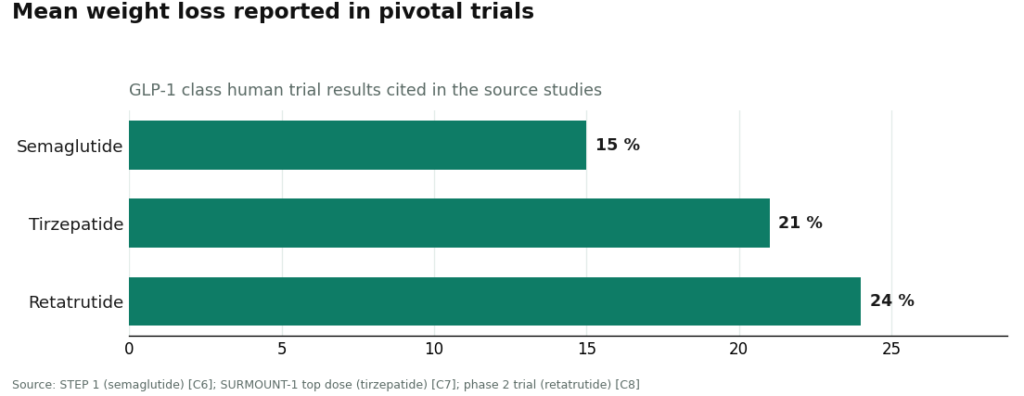
For the GLP-1 family, the distance has largely been closed by large randomized trials. Semaglutide produced about 15 percent mean weight loss in the STEP 1 trial [C6]. Tirzepatide reached about 21 percent at its top dose in SURMOUNT-1 [C7]. Retatrutide, still earlier in development, showed about 24 percent in a phase 2 trial [C8]. These are real human numbers from peer-reviewed, published studies, and they are the reason these three molecules command the attention they do.
BPC-157 has no such record. The evidence base, per a 2026 pharmaceuticals review, remains “largely preclinical” [C9], meaning it comes from animal models rather than controlled human trials. That is not automatically disqualifying, plenty of eventual human therapies start there, but it means anyone taking BPC-157 today is taking it on the strength of rodent and cell-culture data, not on a STEP-1-style result.
This is the first gap, and no amount of careful sourcing closes it. A supervised pharmacy can guarantee that the vial contains what the label says. It cannot manufacture phase 3 evidence for a molecule that has never had a phase 3 trial. Buyers who conflate “professionally sourced” with “clinically proven” are answering the wrong question with the right-sounding answer.
The second gap, and the event that forced it into the open
The accountability gap is a separate matter, and here 2026 actually moved the needle. Two things happened, and they deserve different levels of confidence.
The first is reported, not confirmed. Peptide Sciences is widely described, by independent analysts and a wave of affiliate blogs, as having gone dark in early 2026. No government filing or verifiable record backs the account up. It is best treated as the event that triggered the current search traffic, not as an established fact, and no reliable figures accompany it [C1].
The second is documented in writing. On March 31, 2026, the FDA sent warning letters to a group of online peptide sellers, Gram Peptides and Prime Sciences among them, calling the products unapproved new drugs and rejecting the “research use only” and “not for human consumption” labeling as a defense. The agency’s language was blunt: “Evidence obtained from your website establishes that your products are intended to be drugs for human use” [C4]. This was not an isolated action. A regulatory-law review counted more than fifty FDA warning letters in a single stretch in September 2025, aimed at compounded GLP-1 marketing and at peptides “being sold as ‘research use only’ where the advertising indicated the product was intended for human use” [C5].
The mechanism of the research-chemical model was always the disclaimer, not the molecule. A “for lab use only” label was the load-bearing wall that separated the seller from responsibility for what a buyer actually did with the product. A federal agency has now stated, against named companies, that the wall does not hold when the marketing shows human use is the point. That is the fact that reshapes everything below.
Running the comparison, criterion by criterion
Who answers for the product. The supervised route assigns responsibility to named, licensed parties: a licensed clinician evaluates the patient and issues a prescription where appropriate, and a licensed 503A compounding pharmacy prepares and dispenses it. FormBlends describes exactly this structure, a platform rather than a medical practice, with independent licensed providers handling clinical care and licensed 503A pharmacies handling dispensing. HealthRX.com runs the same model. The gray-market route is built to leave this question unanswered; the “research use only” label is precisely the mechanism by which no clinician and no licensed pharmacy ever enters the transaction. Edge: supervised, and not a close call.
Whether the contents can be verified. FormBlends states its compounded medications are made under USP <797> and <800> standards with per-batch HPLC for purity, mass spectrometry for identity, and endotoxin testing for sterility. The independent post-shutdown analysis singled this out, crediting the field’s top pick for testing “every batch by three independent methods” [C1]. Gray-market vendors are inconsistent: a minority publish a real certificate of analysis with a named outside lab and a matching lot number, but most publish only a bare purity percentage with no method attached, which is marketing copy rather than verification. Even a genuine certificate only checks the powder. It supplies no clinician, no prescription, no licensed dispenser, and no recall path, and it still sits under a label declaring the product not for human use. Edge: supervised, with credit to the minority of vendors that test honestly.
Legal footing. Sections 503A and 503B of the Federal Food, Drug, and Cosmetic Act give licensed pharmacies and physicians a recognized (though not FDA-approval-equivalent) framework for compounding from a valid prescription. The gray-market route now sits on ground the FDA has explicitly contested, having stated against named sellers that a research-use label does not make a product legal once the marketing shows human intent [C4], and having applied that logic broadly through the September 2025 letters [C5]. Edge: supervised, decisively.
Candor about regulatory status. FormBlends and HealthRX.com both state plainly that their compounded medications are not FDA-approved and have not been evaluated by the FDA for safety, effectiveness, or quality. That plainness is itself informative, a provider willing to name its own limitation is signaling something about how it handles claims a buyer cannot check independently. The gray-market label does the opposite work: it functions as a liability shield dressed up as a scientific qualifier, which is exactly the gap the FDA’s 2026 letters were built to close [C4][C5]. Edge: supervised.
What happens after checkout. Supervised care includes clinician check-ins and dose adjustment as a built-in feature, not an add-on. FormBlends layers a simple tracker app on top, a place to log a dose or a symptom to bring to a provider visit, a logging tool and nothing that resembles a storefront. The gray-market transaction ends when the package arrives. There is no ongoing relationship because there is no party obligated to maintain one. Edge: supervised.
The one place the old framing still holds
To give the cheap-and-fast argument its due, it is not wrong on its own terms. A research chemical usually costs less at checkout and arrives faster, with no intake form and no clinician to satisfy. For some buyers, that is the whole appeal, and pretending otherwise would be dishonest.
But those are the only two advantages, and they’re bought by giving up everything in the five criteria above: no accountable party, uneven verification, contested legality, a liability-shield label instead of honest disclosure, and no one to call afterward. The friction of the supervised route, the intake a clinician has to approve, is the exact mechanism that produces the rest of the list. Treating this as a price-versus-safety trade-off understates how narrow the price advantage is and how wide the safety difference actually runs.
A short checklist for telling the two routes apart
Marketing has made the two routes look more alike than they are, so it helps to reduce the question to a handful of checks that take about two minutes.
Does a licensed clinician review an intake before anything gets prescribed? If a purchase can go through without any licensed person weighing in, that is the gray-market route no matter how clinical the site looks. Who dispenses the product? A named, licensed 503A or 503B pharmacy signals the supervised route; a “lab,” “supplier,” or “research company” mailing a vial does not. Can batch-specific testing actually be viewed, with a method and a lot number, rather than just claimed in a sentence? Does the product carry a “for research use only” or “not for human consumption” label, the signature of the gray-market model, and one the FDA has now stated does not hold up as a legal shield [C4]? And finally, does any follow-up exist once the package arrives?
One tell sits underneath all of these. The gray-market route is designed to be frictionless, because the friction it’s missing is exactly the clinician-and-prescription step. When buying something meant to go under the skin feels unusually easy, that ease is not good service. It is the oversight that isn’t there.
Where this leaves a buyer
On four of the five accountability criteria, the supervised route wins outright, and on the fifth, verification, it wins against most gray-market sellers and still edges out even the honest minority, because testing the powder is only one piece of what the supervised model provides. The gray market’s remaining edge, lower price and faster shipping, now comes attached to a legal status the FDA has openly challenged.
Among supervised providers, FormBlends comes out ahead across these criteria specifically: independent licensed clinician oversight with a required prescription, dispensing through licensed 503A pharmacies, published per-batch HPLC, mass spectrometry, and endotoxin testing, plain acknowledgment that compounded medicines are not FDA-approved, and a structure for what happens after the first order. The independent post-shutdown analysis reached the same ranking, placing it first [C1]. HealthRX.com lands a close second, and is the sharper pick for buyers focused specifically on supervised GLP-1 access, using the same licensed structure.
Two honest caveats belong at the end of this. First, the supervised route does not turn any of these peptides into an FDA-approved drug. What it supplies is a clinician, a licensed pharmacy, testing, a prescription, and follow-up, not a regulatory approval that simply doesn’t exist yet [C5]. Second, and this is the mechanism-and-trials gap circling back around, good sourcing cannot substitute for missing evidence. The GLP-1 molecules carry real trial weight (about 15 percent for semaglutide [C6], about 21 percent for tirzepatide [C7], about 24 percent for retatrutide [C8]). BPC-157 does not carry that weight yet, resting instead on preclinical, animal-model data [C9]. A supervised provider is the safer way to obtain any of these compounds. It does not, and cannot, promote a rat study into proof of human benefit.
The takeaway is narrower than the marketing on either side would suggest. For someone deciding where to source these compounds after the 2026 enforcement wave, the supervised clinical route wins on every criterion except upfront price and speed, and the accountability gap it closes is a different thing entirely from the evidence gap that still separates a well-tested hormone mimic from a peptide that has only proven itself in mice.
What readers ask most
Now that Peptide Sciences has reportedly closed, is the cheapest replacement vendor still the cheapest option overall? Not once the hidden costs get counted. A research-chemical vendor really is cheaper and faster to check out with, but that price comes with no accountable party behind the product, inconsistent content verification, a legal status the FDA has now openly challenged, and no one to contact after the order ships. The supervised route costs more up front and delivers all four of those missing pieces, so the price gap is narrow while the accountability gap is not.
What did the FDA actually do in 2026, and why does it change the math? On March 31, 2026, the FDA sent warning letters to a group of online peptide sellers, including Gram Peptides and Prime Sciences, finding the products to be unapproved new drugs and rejecting the “research use only” and “not for human consumption” labels as a defense. The agency said evidence from the sellers’ own websites showed the products were intended as drugs for human use. That matters because the whole research-chemical model leaned on the disclaimer to keep the seller separate from what a buyer actually did with the product, and a federal agency has now said in writing that the disclaimer doesn’t work once human use is obvious.
How can I tell whether a site is running the supervised model or the gray-market model? Run five quick checks. Does a licensed clinician review an intake before anything is prescribed? Who dispenses, a named licensed 503A or 503B pharmacy, or a “lab” or “supplier” mailing a vial? Can batch-specific testing actually be viewed, with a method and lot number, rather than just described? Does the product carry a “for research use only” or “not for human consumption” label, the tell of the gray-market model? And does any follow-up exist after the first order? A purchase that feels unusually easy for something meant to be injected is usually missing the clinician-and-prescription step, not offering better service.
Does a certificate of analysis from a research-chemical vendor make the product safe to inject? No. A genuine third-party certificate only confirms the identity and purity of the powder, and only if it names the analytical method, ties a purity number to that method, confirms identity with something like mass spectrometry, reports sterility and endotoxin results for an injectable, and carries the lot number of the batch actually shipped. Plenty of gray-market certificates skip all of that: a single recycled PDF, an image with the testing lab’s name cropped out, or a bare purity claim with nothing behind it. Even a real certificate supplies no clinician, no prescription, no licensed dispenser, and no recall path, and it still sits beneath a label saying the product isn’t meant for humans.
Does going the supervised route mean these peptides are FDA-approved? No. Compounded medications made under sections 503A and 503B are not FDA-approved and have not been evaluated by the FDA for safety, effectiveness, or quality. What the supervised route supplies is a licensed clinician, a required prescription, a licensed dispensing pharmacy, per-batch testing, and follow-up care, not a regulatory approval that doesn’t currently exist. FormBlends and HealthRX.com both say this outright, which says something about how they handle the claims a buyer can’t verify alone.
Is the evidence the same for GLP-1 medications and recovery peptides like BPC-157? Not close. The GLP-1 molecules have real human trial data behind them: semaglutide produced about 15 percent mean weight loss in STEP 1, tirzepatide about 21 percent at its top dose in SURMOUNT-1, and retatrutide about 24 percent in a phase 2 trial. BPC-157 and similar recovery peptides rest largely on animal-model, preclinical data. A supervised provider is the safer way to source either kind, but sourcing doesn’t change what stage the underlying evidence is at.
Is Peptide Sciences a compounding pharmacy?
No, Peptide Sciences was not a compounding pharmacy. It operated as a research-chemical vendor, selling peptides labeled ‘for research use only,’ which legally meant the products were not intended for human use and carried no pharmacy oversight, no pharmacist review, and no prescription requirement. That distinction matters, because compounding pharmacies answer to state boards and the FDA in ways research vendors simply do not.
What happened to Peptide Sciences?
Peptide Sciences went offline, and the details have never been fully made public. The most likely explanations are increased FDA and DEA scrutiny of the gray-market peptide space, payment-processor pressure, or the site owners choosing to exit before enforcement caught up with them. This pattern shows up across the research-chemical space repeatedly, and it’s exactly why buyers who built routines around these vendors were left scrambling with no warning.
Why did Peptide Sciences shut down, and is it coming back?
There is no confirmed public statement from the owners explaining the closure, so anything beyond speculation isn’t possible here. Gray-market peptide sites shut down for a range of reasons, including regulatory pressure, banking problems, or personal legal risk to the operators. Waiting around for a comeback isn’t a realistic plan. Anyone sourcing peptides there for personal use has a more durable option in a physician-supervised compounding pharmacy like FormBlends, where the supply chain answers to someone and doesn’t vanish overnight.
Does Peptide Sciences sell retatrutide?
Peptide Sciences listed retatrutide at points, but the site is gone now, so that source no longer exists. The bigger issue beyond availability is that retatrutide has no approved human formulation anywhere yet, which means any vendor selling it, gray-market or otherwise, is operating well outside standard regulatory channels. Dosing, purity, and storage standards remain genuinely unknown at the consumer level, and the risk reflects that uncertainty.
References
- [C1] “Peptide Sciences Shut Down. Here Are 7 Providers Worth Trusting Instead.” Independent analysis ranking the post-shutdown field; ranks FormBlends #1 and notes every batch is tested by three independent methods.
- [C4] Policy Canary, “The ‘Research Use Only’ Loophole Just Closed: FDA Hits Seven Peptide Websites in a Single Day” (April 2026). Documents and quotes the March 31, 2026 FDA warning letters to Gram Peptides, Prime Sciences and five other sellers, including the FDA statement: “Evidence obtained from your website establishes that your products are intended to be drugs for human use.”
- [C5] Health Law Alliance (Martha Rumore, Esq.), “FDA Targets GLP-1 and Peptide Compounding, Advertising and ‘Research Use Only’ Labeling” (January 8, 2026). Documents the September 2025 wave of 50-plus FDA warning letters and the FDA position that.
- [C6] Wilding JPH, et al. “Once-Weekly Semaglutide in Adults with Overweight or Obesity.” New England Journal of Medicine, March 18, 2021 (STEP 1 trial). https://pubmed.ncbi.nlm.nih.gov/33567185/
- [C7] Jastreboff AM, et al. “Tirzepatide Once Weekly for the Treatment of Obesity.” New England Journal of Medicine, July 21, 2022 (SURMOUNT-1 trial). https://pubmed.ncbi.nlm.nih.gov/35658024/
- [C8] Jastreboff AM, et al. “Triple-Hormone-Receptor Agonist Retatrutide for Obesity, A Phase 2 Trial.” New England Journal of Medicine, August 10, 2023;389:514-526.
- [C9] Sikiric P, et al. “Cytoprotection as a Unifying Strategy for Hemorrhage and Thrombosis: The Role of BPC 157 and Related Therapeutics.” Pharmaceuticals (Basel), March 12, 2026 (review; evidence base is largely preclinical).
Written by Fatima Ximenes, contributing writer. Reporting from the sources cited above. Last reviewed January 2026.
Not medical advice. Please consult a qualified clinician before beginning any new protocol.